Overview
The Cultural Affairs Office of Thailand has been an active participant in the Ambassadors Fund for Cultural Preservation (AFCP) since its establishment in 2001. The AFCP program was designed to enable U.S. Ambassadors around the world to support the preservation of a wide range of cultural heritage including historic buildings, archaeological sites, museum collections, paintings, manuscripts, and endangered Indigenous languages that might otherwise disappear.
The AFCP program in Thailand has earned recognition from cultural officials, conservators, and academics for its impactful work. In 2017, the AFCP program was honored with the prestigious Architectural Conservation Award (Category: Organization) by the Association of Siamese Architects (ASA) under Royal Patronage. This distinguished award, graciously presented by Her Royal Highness Princess Maha Chakri Sirindhorn since 1982, underscores the program’s significant role in preserving Thailand’s architectural heritage. It also highlights the enduring partnership between the United States and Thailand in safeguarding cultural treasures for future generations.
AFCP Projects in Thailand
2021: Collaborative Investigation and Conservation of Ancient Log Coffins of Phi Man Long Long Rak Cave in Mae Hong Son (US$220,000) — To be completed in early 2025
2020: Preservation of the 17th-Century Wat Chaiwatthanaram in Ayutthaya, Phase Three (US$260,000)
2019: Conservation of Traditional Lanna Architecture in Chiang Mai (US$150,000)
2017: Preservation of the 17th-Century Wat Chaiwatthanaram in Ayutthaya, Phase Two (US$325,000), and Conservation of 19th-Century Objects in the Royal Collection of the Maharajanusorn King Rama IV Museum in Bangkok (US$24,000)
2016: Preservation of Ancient Palm Leaf Scriptures at Community Center at Pumriang District in Suratthani (US$15,000)
2014: Vernacular Architecture Documentation in the Canal Community of Khlong Bang Luang in Bangkok (US$53,960)
2013: Preservation of the 17th-Century Wat Chaiwatthanaram in Ayutthaya, Phase One (US$1,047,000)
2012: Documentation and Assessment of the 17th-Century of Wat Chaiwatthanaram in Ayutthaya (US$131,800)
2011: Documentation of Ramayana Mural Paintings at Wat Suthat Thepwararam in Bangkok (US$25,650)
2010: Documentation of Akha Cultural Traditions in Chiang Rai (US$77,928)
2009: Community Based Architectural Heritage Preservation in Phrae (US$20,000)
2007: Documentation of Historic Buildings on Northern Charoen Krung Road in Bangkok (US$15,900), and Conservation of Mural Paintings (Hoop-Tam) in Mahasarakham (US$34,000)
2006: Archaeological Heritage Management at Ban Rai and Tham Lod Rockshelters in Mae Hong Son (US$34,600)
2005: Preservation of the Mural Painting at Wat Baan Koh in Lampang (US$52,800)
2004: Preservation of Southern Thailand’s Architectural Islamic Heritage through Digital Database Archive and Traveling Exhibition (US$9,345)
2003: Preservation of Traditional Thai Textile Patterns and Weaving Techniques at the Golden Jubilee Royal Goldsmith College, The Grand Palace in Bangkok (US$22,500)
2002: Preservation of Antique Textile Collection of the National Museum Bangkok (US$13,500)
2001: Preservation of Kamthieng House at the Siam Society Under Royal Patronage in Bangkok (US$5,000)
Total awards: 20 awards
Total contribution: US$2,537,983
Wat Chaiwatthanaram Conservation Project
The U.S. Ambassadors Fund for Cultural Preservation (AFCP) Wat Chaiwatthanaram Conservation Project was a collaborative effort between the U.S. Department of State, Thailand’s Fine Arts Department, and World Monuments Fund (WMF). The project aimed to restore the 17th-Century Wat Chaiwatthanaram in Phra Nakhon Si Ayutthaya province after the temple suffered damage from the 2011 floods.
Running from 2012 to 2024 for a total of 12 years, this project was funded by the U.S. government for a total of 1.8 million U.S. dollars. Key activities and conservation efforts included a study of the temple area to develop a water management plan, the design of a floodwall on the southern side of the temple, the restoration of four Merus (conical pavilions) and their connecting cloisters, mural paintings, and buddha image statues, and the renovation of an information pavilion to house temple replicas and improve accessibility at the temple main entrance.
In addition to providing financial support for the restoration, U.S. Embassy Bangkok organized public diplomacy activities for high school and university students, and the local community. These activities aimed to raise awareness of U.S. government support for cultural heritage conservation and the importance of conservation work, as well as to develop the capacity of Thai personnel in conservation work and produce short documentaries to communicate the significance of the project to the general public.
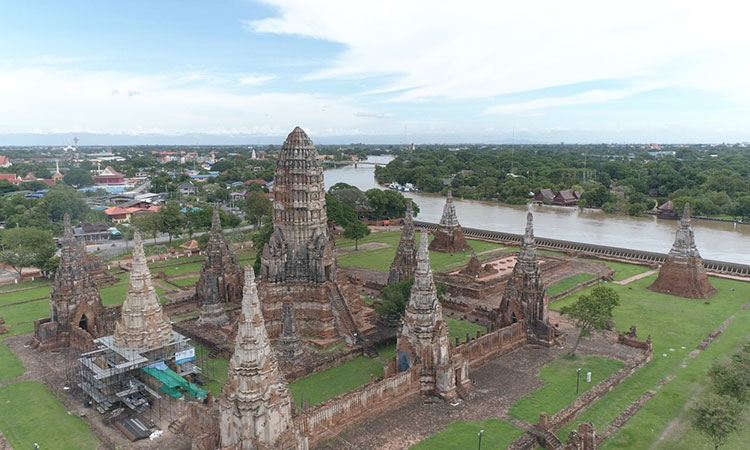
This project serves as a successful example of cultural heritage conservation collaboration in Thailand and strengthens the relationship between the United States and Thailand. The project’s significant outcomes include the restoration of Wat Chaiwatthanaram to its original state prior to the flood, increased awareness and community involvement in cultural heritage conservation, and the promotion of conservation-based tourism at Wat Chaiwatthanaram.
